- Clinica Veterinaria Eurovet - Avenida Estación, 38 - 12598 - Peñiscola
- +34 964 784 983
- +34 671 281 025
- clinica.eurovet@gmail.com



Know your enemy II
Intestinal protozoa, the invisible ones
Protozoa are single-celled organisms that frequently affect the digestive system of dogs and cats, especially in young animals, recently adopted animals, or animals from crowded environments such as breeding facilities or shelters. According to a recent review, in Europe, the published prevalence of Giardia in dogs and cats can vary greatly depending on the country, population and diagnostic method: from 0.4% to 55.2% in dogs and from 1.23% to 23.08% in cats. Unlike helminths, these parasites are not visible to the naked eye and many can remain in a cystic state for weeks in the environment or in water, waiting to be ingested to reactivate. Their ability to cause persistent or intermittent diarrhoea, malabsorption and weight loss makes them a silent threat to the animal’s well-being. In addition, some protozoa are zoonotic, posing a direct risk to humans, especially children or immunocompromised individuals. Early detection and proper treatment are essential, as these parasites can go unnoticed for months while damaging the intestinal microbiota and weakening the immune system. That is why it is so important not to normalise chronic or recurrent diarrhoea in pets and to always seek veterinary advice if loose stools last more than a few days or recur frequently. As a practical reference, a classic European meta-analysis estimated pooled prevalences in symptomatic animals to be close to 15.2% in dogs and 12% in cats, highlighting how common it can be when diarrhoea is present.
Giardia duodenalis, the difficult-to-control parasites
Giardia duodenalis, also known as Giardia intestinalis or Giardia lamblia, is a flagellated protozoan that attaches itself to the mucosa of the small intestine, altering nutrient absorption and causing intermittent diarrhoea, soft, pasty or shiny stools, excess gas and a characteristic foul odour. It particularly affects puppies and stressed animals, or those that have recently undergone changes in their home or diet. In field studies, positivity can be especially high in selected populations: for example, in a study in Spain with sampled dogs and cats, Giardia was the most common protozoan in dogs (40.9%).
Did you know? “In the park, one in five…”
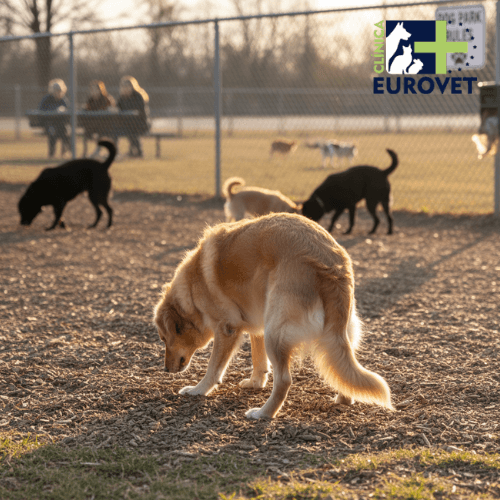
A European study of dogs in parks found a 22.8% positivity rate for intestinal parasites, with Giardia being the most common (17.3%). In addition, 83.5% of the parks sampled showed the presence of Giardia in the environment, reminding us that the risk is not always “smellable” or visible.
Giardia has two forms in its life cycle: the trophozoite, which attaches to the intestine and causes clinical damage, and the cyst, which is eliminated into the environment and is highly resistant to humidity and variable temperatures. These cysts survive for weeks in puddles, fountains, outdoor drinking fountains, and damp soil, maintaining the cycle of infection. According to the ESCCAP fact sheet on Giardia, cysts are “immediately infectious” after being shed, and “only a few cysts” can cause infection, which explains why outbreaks can be so persistent in multi-pet households or community settings.
A dog can become infected simply by licking the ground, drinking contaminated water, or grooming itself after stepping in contaminated faeces.
Although many dogs may be infested without showing obvious symptoms, they continue to shed cysts and can infect other animals and humans. Diagnosis may require repeated testing, as cyst shedding can be intermittent. Treatment should combine specific antiparasitic drugs with rigorous environmental hygiene, regular bathing to remove cysts from the coat, and disinfection measures in the home. It is advisable to clean floors with appropriate disinfectants, minimise humidity in indoor areas and wash the animal’s blankets and beds frequently. A very specific practical recommendation is to wash textiles/utensils at 60 °C or higher, as stated by ESCCAP, because environmental control is Giardia’s Achilles heel. At Eurovet, we insist that if an animal suspected of having Giardia lives with others, all members of the group must be evaluated before the problem is considered resolved, and during treatment it is recommended to use short leashes on walks and avoid access to puddles, ditches or shared drinking troughs.
Coccidia, tiny invaders of the intestine
Coccidia belong to the genus Cystoisospora in dogs and cats and are especially prevalent in environments with a high density of animals, such as shelters and breeding facilities. They reproduce within the cells of the intestine, destroying the intestinal epithelium as they progress through their cycle. This cell destruction causes severe enteritis, with diarrhoea that can be profuse, watery or even bloody in the most severe cases. In dogs, published surveys show wide ranges: the CAPC summarises the presence of coccidia as “3% to 38%” in different North American series, illustrating how age and type of population (home vs. kennel/shelter) greatly change the risk.
Puppies are the main victims, as their immune systems are not yet able to control the rapid multiplication of coccidia. If diarrhoea is prolonged, dehydration, rapid weight loss and growth retardation can occur, situations that can seriously compromise their survival if action is not taken quickly. Animals often also experience general discomfort and difficulty maintaining a good body condition even though they are eating normally, because the intestine is unable to absorb nutrients properly.
Diarrhoea that appears immediately after adoption
It is no coincidence that many dogs and cats develop diarrhoea within a few days of arriving at their new home after adoption. The stress of the change can ‘awaken’ a coccidia infection that was previously contained. For this reason, in shelters and breeding facilities, coccidiosis is known as the disease that waits for the right moment, appearing when the defences are down.
Coccidia oocysts are eliminated in faeces and become infectious after a short period in the environment, facilitating reinfection in areas where many animals are kept together. Environmental hygiene is crucial to controlling the disease: frequent removal of faeces, disinfection with effective products and avoidance of moisture accumulation. Treatment, although generally effective, must be complemented with nutritional support and hydration. In puppies, it is especially important to provide fresh, clean water at all times and to follow the vet’s dietary recommendations (easily digestible diets, split meals, etc.). Eurovet’s commitment to young animals drives us to take any recurrent diarrhoea in puppies very seriously, as it immediately raises suspicion of coccidiosis. To put a figure on this “reality of shelters/communities”: in a study of dogs in public kennels, Cystoisospora appeared in 20% of young dogs (<1 year) compared to 4.9% in adults.
Toxoplasma gondii, the famous cat parasite
Toxoplasma gondii is one of the best-known zoonotic parasites and is mainly associated with cats, which act as the definitive host. Most infected cats show no symptoms and only shed oocysts for a short period of their lives. These oocysts can survive for months in the environment and contaminate soil, gardens and litter boxes. Other animals (including humans) can become infected by ingesting contaminated food or soil, or raw meat containing tissue cysts. In the US (NHANES 2011–2014), 5.1% of participants had antibodies to Toxocara, estimating more than 12 million people exposed. This serves to quantify what we call “One Health” in our practice: pet-home-public health.
“Who are the confirmed zoonotic ‘culprits’?”
In human toxocariasis, confirmed zoonotic agents include T. canis (dog) and T. cati (cat). Knowing “who’s who” helps to focus prevention: deworming + hygiene + control of soil/sand where children play.
Source: https://www.cdc.gov/dpdx/toxocariasis/index.html CDC
In cats that do show symptoms, fever, apathy, diarrhoea or respiratory or neurological signs may appear, especially if there is immunosuppression. The importance of Toxoplasma lies mainly in its impact on humans: in pregnant women who have not had previous contact with the parasite, infection can cause miscarriages or foetal malformations. However, it is essential to clarify a key point: it is not spread by petting a cat, but by contact with fresh cat faeces without proper hygiene or by consuming contaminated food. And here is the fact that changes prevention: the CDC (2025) explains that oocysts eliminated by cats need 1–5 days in the environment to sporulate and become infectious, and that elimination usually lasts 1–3 weeks. This detail is essential to avoid unnecessary abandonment and to reassure families, according to the CDC DPDx – Toxoplasmosis page (May 2025). Along the same lines, the CAPC emphasises that these oocysts can survive “months to years” in the environment, hence the importance of litter tray and soil/garden management.
At Eurovet, we provide personalised preventive advice for pregnant women, teaching simple but effective measures that allow them to live with cats without any risk: avoid handling the litter tray without gloves, clean it daily (before the oocysts become infectious), cook meat thoroughly and always maintain rigorous hygiene. If possible, it is recommended that someone else in the household take care of cleaning the litter tray during pregnancy and that gardening without gloves be avoided on soil where cats may have defecated. Responsible and well-informed coexistence is the key to eliminating unjustified fears.
Protozoa, an invisible threat that requires constant vigilance
Intestinal protozoa are discreet but have the ability to cause persistent illness, chronic discomfort and family transmission, even before they are detected. Strengthening prevention, hygiene and veterinary controls eliminates this risk and protects the health of all of us who live with our animals. Not ignoring chronic diarrhoea, keeping up with check-ups and requesting specific tests when recommended by your vet are essential steps in keeping these “invisible enemies” at bay.
Sources and recommended reading
ESCCAP (European Scientific Counsel Companion Animal Parasites) (2019) – Giardia infection in dogs and cats (Fact sheet) – ESCCAP – Technical reference document describing the biological cycle of Giardia, its immediately infectious nature, environmental hygiene measures and the recommendation to wash textiles at ≥60 °C as a pillar of control.
https://www.esccap.org/uploads/docscdikjk78_1056_ESCCAP_Giardia_Fact_Sheet__Spanish_v2.pdf
ESCCAP (European Scientific Counsel Companion Animal Parasites) (2019) – Giardia infection in dogs and cats (Fact Sheet) – ESCCAP – Official fact sheet detailing the high environmental resistance of cysts, the low infectious dose and the importance of environmental control in homes and communities.
https://www.esccap.org/link-document/178/
Centres for Disease Control and Prevention (CDC) (2025) – Toxoplasmosis – CDC, DPDx – Official resource explaining the cycle of Toxoplasma gondii, including the key fact that oocysts require 1–5 days to become infectious and that feline excretion usually lasts 1–3 weeks.
https://www.cdc.gov/dpdx/toxoplasmosis/index.html
Companion Animal Parasite Council (CAPC) (2025) – Toxoplasma gondii – Guidelines – CAPC – Clinical guidelines summarising the prolonged survival of oocysts in the environment and key preventive recommendations for animals and humans.
https://capcvet.org/guidelines/toxoplasma-gondii/
Companion Animal Parasite Council (CAPC) (2025) – Coccidia – Guidelines – CAPC – Summary of epidemiological data showing wide ranges of coccidia prevalence, with a particular impact on puppies and community animals.
https://capcvet.org/guidelines/coccidia/
Epe, C., Rehkter, G., Schnieder, T., Lorentzen, L., Kreienbrock, L. (2010) – Giardia in symptomatic dogs and cats in Europe – Results of a meta-analysis – Veterinary Parasitology – European meta-analysis estimating pooled prevalences of approximately 15.2% in dogs and 12% in cats with digestive symptoms.
https://www.sciencedirect.com/science/article/abs/pii/S0304401710003481
Mateo, M., Montoya, A., Martínez-Carrasco, C., et al. (2023) – Prevalence and public health relevance of enteric parasites in dogs and cats from Spain – Parasites & Vectors – Epidemiological study identifying Giardia as the most common protozoan in dogs (40.9%) within the population studied.
https://pmc.ncbi.nlm.nih.gov/articles/PMC10650246/
Ilić, T., Kulišić, Z., Antić, N., et al. (2021) – Prevalence of intestinal parasites in dogs from public shelters – Veterinary Parasitology – Study demonstrating a significantly higher prevalence of Cystoisospora in young dogs (20%) compared to adults (4.9%) in kennels.
https://pubmed.ncbi.nlm.nih.gov/33930631/
Jańczak, D., Sroka, J., Karamon, J., et al. (2025) – Prevalence of Giardia duodenalis genetic assemblages in dogs and cats in Europe – Parasites & Vectors – Review documenting extremely variable prevalence ranges in Europe, from less than 1% to more than 50%, depending on population and diagnostic technique.