- Clinica Veterinaria Eurovet - Avenida Estación, 38 - 12598 - Peñiscola
- +34 964 784 983
- +34 671 281 025
- clinica.eurovet@gmail.com



Anti-Tick Mission:
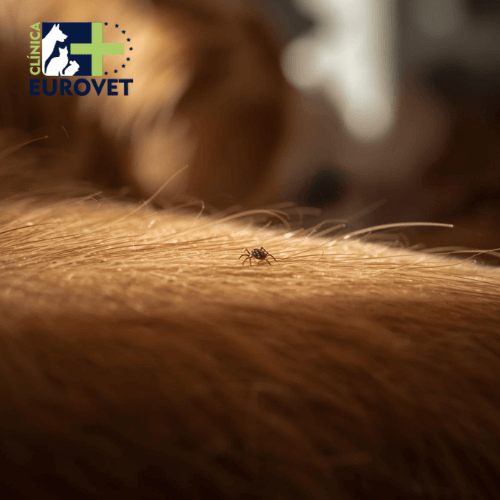
Secret Life and Danger to Your Dog
Ticks are not just a seasonal nuisance. They are blood-feeding ectoparasites—external parasites that feed on blood—perfectly adapted to survive in changing environments and to take advantage of any opportunity to attach themselves to a host. Their presence poses a real health risk to dogs, cats and also humans, as several of the diseases they transmit are zoonotic. In Europe, for example, the annual incidence of Lyme disease in humans ranges from almost anecdotal values to approximately 460 cases per 100,000 inhabitants in certain regions, reflecting a very uneven but potentially very high impact depending on the area.
Any animal that spends time outdoors becomes a target, so it is advisable to check your pet’s skin after every walk, especially in areas where the skin forms folds or is thinner: ears, armpits, groin, neck or between the toes. In daily practice, it has been observed that many owners detect the tick when it is already deeply embedded, indicating that it has been feeding on the animal for between 24 and 72 hours, a sufficient time window for some pathogens to be transmitted.
Spain: infestations detected by surprise during consultations
In a study conducted in Spanish veterinary clinics, 76.8% of the dogs examined had at least one tick at the time of the visit, even though they had come for other reasons. The dominant species was Rhipicephalus sanguineus, which is highly adapted to dogs and the domestic environment.
📌 Source: https://pubmed.ncbi.nlm.nih.gov/28188085/
Ticks are usually found in temperate and humid climates, where they are able to remain active for much of the year. They can go long periods without feeding, lying in wait in vegetation, where they detect the passage of an animal through signals such as body heat and carbon dioxide expelled by living beings. Studies on the biology of these mites describe life cycles that can last up to two or three years, provided that the environment allows them to alternate between phases of activity and rest without drying out.
Once they locate a suitable host, they attach themselves using a specialised mouthpart called a hypostome, equipped with spicules that act as small hooks, and begin a prolonged intake of blood. If a tick is found at this point, it should be removed with special tweezers, applying firm and continuous traction and avoiding inappropriate techniques such as oils, burns or sudden movements that may increase the risk of pathogen transmission or leave fragments inside the skin. After removal, it is advisable to disinfect the area and monitor the animal for several days for any marked redness, inflammation or general discomfort.
A thorough understanding of how their biological cycle evolves is the most effective tool for preventing colonisation of the environment and transmission of pathogens.
The prodigious four-stage life cycle
The life cycle of ticks consists of four successive stages: egg, larva, nymph and adult. Each stage requires a blood meal to progress to the next, and the entire process can take several months or even more than two years, depending on temperature, humidity and the specific species. Some sources describe the complete cycle, from egg to adult, as taking 24–36 months in temperate climates, which means that the same environment can support several overlapping generations at different stages.
Did you know? The tick that moves with you
Rhipicephalus sanguineus can complete its cycle inside houses or kennels, progressing from egg to adult without needing to go outside. Adults and nymphs can survive hidden in cracks for more than 500 days, making a domestic infestation very persistent if it is not stopped in time.
📌 Source: https://wcvm.usask.ca/learnaboutparasites/parasites/rhipicephalus-sanguineus-brown-dog-tick.php
After feeding, the adult female detaches herself from the host and lays thousands of eggs in protected places: the bases of walls, leaf litter, gardens, or cracks. Various studies estimate that a single female can lay between 2,000 and more than 5,000 eggs before dying, which illustrates the enormous potential for an infestation to spread if the cycle is not properly broken. To reduce the concentration of these eggs in outdoor areas frequented by the family, it is useful to keep the grass short, periodically remove leaf litter and prevent tall vegetation from coming into direct contact with the home, creating a kind of weed-free “safety strip” around passageways.
After hatching, hexapod larvae less than a millimetre long emerge, almost invisible to the human eye, and seek their first host to transform. At this stage, they usually parasitise small mammals or birds, which act as reservoirs without the dog or cat owner being aware of it. Therefore, in rural or peri-urban areas where rodents and wildlife are abundant, it is common for domestic animals to come into contact with ticks that have already acquired pathogens from a previous host.
After feeding, the larvae moult into nymphs, which already have the eight legs typical of adult mites. Despite their small size, nymphs can be highly infectious, and it is precisely their inconspicuousness that causes many infections to go unnoticed in their early stages. Recent data show that, in some field studies, a significant percentage of ticks analysed in dogs and cats carry at least one pathogen: in a recent study with pets, approximately 26% of adult ticks tested positive for Borrelia and around 9% for other agents such as Anaplasma or Babesia, confirming that a significant proportion of the ticks we remove in our clinics are carriers of potentially pathogenic microorganisms. Checking pets after trips to wooded or damp areas significantly reduces the likelihood of these nymphs going unnoticed.
Finally, nymphs moult into adults, which tend to seek out larger animals such as dogs, cats or even humans. Reproduction occurs at this stage, which is why continuous prevention in domestic animals is crucial to breaking the cycle and protecting the home. Using antiparasitic products recommended by your vet not only eliminates existing parasites, but also prevents them from completing their cycle in the home environment. Organisations specialising in companion animal parasitology point out that, based on millions of diagnostic tests collected each year, the risk of exposure to tick-borne diseases is persistent and dynamic, which is why they recommend year-round prevention programmes in most regions.
Ticks in all seasons 🧭
The belief that ticks only exist in summer is mistaken. Although they are most active in warm weather, many species hibernate in vegetation and reactivate their metabolism with any rise in temperature, even if it is temporary. In Mediterranean regions such as the Spanish Levante coast, this means that the risk is present for most of the year, with peaks in spring, summer and autumn, but with the possibility of finding active ticks on mild winter days.
In Europe, seroprevalence studies in dogs show that exposure to different tick-borne pathogens is constant. An analysis of large diagnostic databases revealed, for example, that the positivity rate for Anaplasma spp. in European dogs was around 5–7%, while for Ehrlichia spp. it was around 3–4% and for Borrelia burgdorferi sensu lato around 2–3%, with significant variations depending on the country and geographical area. These figures do not mean that all dogs are sick, but they do indicate that a significant percentage have been in contact with these agents, which justifies a sustained prevention policy.
Climate change: new territories affected
Recent research shows that global warming is expanding the habitat of species such as Ixodes ricinus towards northern Europe and higher altitudes. This correlates with an increase in cases of Lyme disease in regions where it was previously almost non-existent.
📌 Source: https://www.mdpi.com/2673-4931/26/1/18
Some tick species are able to survive for more than 500 days without feeding, thanks to an extremely efficient metabolism and energy-saving mechanisms that minimise their physiological expenditure. This biological resistance, repeatedly described in the specialised literature, explains why sporadic or seasonal treatments alone are often insufficient: the parasite can remain dormant in the environment until the anti-parasite protection ceases, at which point it reactivates and resumes its attempts to parasitise animals.
This epidemiological reality makes it advisable to maintain antiparasitic protection twelve months a year, especially if the animal walks in parks and green areas or lives with immunocompromised people or young children, who may be more vulnerable to zoonoses. If a dog or cat lives in a house with a garden, it is advisable to deworm all animals in the household at the same time, as well as to minimise access by rodents, which can act as alternative hosts and keep the infestation active despite treatments on pets. In addition, it is advisable to educate the whole family to carry out regular checks of the animals’ skin and, if in doubt, to consult the vet rather than trying to remove ticks without the appropriate equipment.
More than just a bite: health risks
Ticks act as biological vectors, carrying and transferring various pathogens when they pierce the skin and feed on the host’s blood. Among the diseases that can affect dogs are Lyme borreliosis, canine ehrlichiosis and babesiosis, among others. In the case of Lyme disease, numerous studies confirm that it is the most common tick-borne disease in the northern hemisphere, both in humans and in pets.
In clinical practice, borreliosis can manifest itself with migratory lameness, fever, apathy and, in some cases, chronic joint involvement. Canine ehrlichiosis mainly affects platelets, causing bleeding tendencies, anaemia and alterations in the blood count. Babesiosis, on the other hand, is a blood parasitosis that destroys red blood cells, causing jaundice, severe weakness and, in severe cases, multiple organ failure. Certain European studies have observed that a significant percentage of dogs testing positive for these pathogens had been exposed to ticks without a regular preventive programme, reinforcing the idea that continuous prevention is more effective than treatment after the disease has developed.
Transmission does not always cause rapid signs, so clinical monitoring is essential: lethargy, intermittent fevers, lameness that changes limbs, or pale mucous membranes should be cause for veterinary consultation. If the professional suspects infection, they will perform specific diagnostic tests, such as serology, rapid tests, or blood smears, to confirm the agent involved and establish an appropriate treatment plan.
Prevention in domestic animals thus becomes an indirect shield for the whole family, reducing the possibility of a pathogen reaching the human environment. For this reason, it is recommended to avoid direct contact with ticks handled with bare hands, to wash hands thoroughly after removal and to also monitor for the appearance of strange skin lesions in people who live with animals that have frequently had ticks.
Conclusion
These small creatures have an extraordinary capacity for survival and a potentially serious impact on the health of animals and their human companions. Available epidemiological data show that, in many regions, between 2 and 7% of dogs tested positive for a tick-borne pathogen, and that the incidence of certain diseases, such as Lyme disease, can reach high levels in high-risk areas. Given this situation, understanding their biology, taking action throughout the year and implementing effective preventive protocols are the most reliable steps to prevent them from finding a place in our homes.
A protected pet means a more peaceful family and a safer environment. The combination of information, regular check-ups of the animal and regular use of antiparasitic products is the simplest and most effective strategy for keeping these “garden vampires” at bay.
References and recommended links
Tick lifecycles can last upwards of two to three years – TickLab – “The Tick Lifecycle”
Number of eggs per female and description of the life cycle – Mosquito Hero – “The Life Cycle of a Tick (and Why It Matters to You)”
https://mosquitohero.com/blog/the-life-cycle-of-tick
Tick Talk – “The Life Cycle of a Tick with Photos”
Seropositivity of tick-borne pathogens in dogs in Europe – Miró G. et al. – “Seropositivity of main vector-borne pathogens in dogs from Europe” https://www.ncbi.nlm.nih.gov/pmc/articles/PMC9169295/
Incidence of Lyme disease and other tick-borne zoonoses in Europe – Springer A. et al. – “Zoonotic Tick-Borne Pathogens in Temperate and Cold Regions of Europe”
https://www.frontiersin.org/articles/10.3389/fvets.2020.604910/full
Prevalence of pathogens in ticks collected from dogs and cats – Sormunen J.J. et al. – “Ticks and Tick-Borne Pathogens Encountered by Dogs and Cats in Northern Europe”
https://onlinelibrary.wiley.com/doi/abs/10.1155/tbed/5574554
Current status of Lyme disease in companion animals – Picado R. et al. – “Lyme disease in companion animals: an updated state-of-the-art review”
https://www.ncbi.nlm.nih.gov/pmc/articles/PMC11538231/
Dynamic risk and annual forecasts for vector-borne diseases in pets – Companion Animal Parasite Council – “2025 Annual Pet Parasite Forecasts”
https://capcvet.org/articles/2025-annual-pet-parasite-forecasts/
AVMA – “Annual CAPC pet parasite forecast predicts continuing spread across the United States”
https://www.avma.org/news/annual-capc-pet-parasite-forecast-predicts-continuing-spread-across-us