- Clinica Veterinaria Eurovet - Avenida Estación, 38 - 12598 - Peñiscola
- +34 964 784 983
- +34 671 281 025
- clinica.eurovet@gmail.com



Clinical support during labour
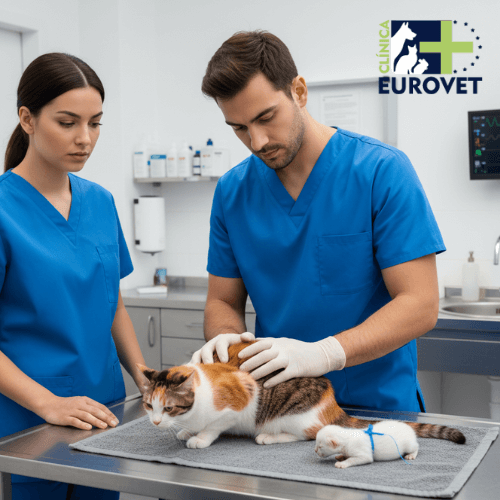
The value of the veterinary team before, during and after birth
Birth may seem simple… until it isn’t. When everything is going smoothly, owners tend to experience it with excitement and a certain calm. But sometimes a single unexpected turn of events—a contraction that does not progress, a foetus that does not advance through the birth canal, or a sudden change in the mother’s condition—is enough to turn the situation from ‘everything is fine’ to ‘this is an emergency’. In practice, it helps greatly if the guardian arrives at that moment with two things prepared: a saved emergency number and a simple transport plan, because when stress levels rise, logistics become awkward.
In dogs, dystocia is a relatively common reason for urgent consultation: a study of first-opinion emergency cases in the United Kingdom described an approximate prevalence of 3.7% within the caseload of emergencies. In insurance company studies (large cohorts), around 2% of insured bitches presented a claim for dystocia over a long period, and among bitches with dystocia, a significant proportion ended up requiring a caesarean section (over 60% in that cohort). In cats, dystocia is described with a mean frequency of 3–8% in purebred cat pregnancies, although the figures vary by population and study design.
At such times, having a trained veterinary team is not a luxury: it is a factor that can determine the outcome. And the important thing is that the team’s work does not begin when complications arise. It begins earlier, with planning, monitoring the pregnancy, anticipating risks and providing practical guidance to the owner. Therefore, when the probable date of birth approaches, it is advisable to have a quiet space ready at home (low light, low noise, no “curious” visitors), clean and absorbent surfaces, and a safe and moderate heat source, avoiding direct electric blankets or “inventions” that can cause burns or overheating. This point is not an “obsession”: in dogs, the overall neonatal mortality rate reported in large studies is usually around 10–15% (with variation by breed, management and context), and a significant proportion of these losses occur at the beginning of life.
Accompanying does not mean intervening “as a matter of course”. It means monitoring with clinical judgement and acting when necessary: neither too soon nor too late. That is the difference between a monitored birth and an unattended birth. And sometimes, that difference is literally what saves lives.
📊 Neonatal mortality: most losses occur when “everything seemed to be going well”
In multicentre studies in dogs, between 65 and 75% of neonatal deaths occur in the first 7 days of life, and a significant proportion occur in litters where the birth was apparently normal. This underlines that immediate postpartum monitoring is as important as the delivery itself.
Source: https://www.sciencedirect.com/science/article/pii/S0167587716306468
The veterinarian is the first pillar of medical and surgical care 🩺
Before delivery, the veterinarian performs a complete clinical evaluation and uses diagnostic tools, especially ultrasound (which allows assessment of the foetal and maternal condition) and, when appropriate, X-rays to estimate the number of offspring and their size. At this stage, the aim is to detect warning signs and plan ahead. For example, if there is a history or findings compatible with the risk of dystocia (difficulty in giving birth), a scheduled caesarean section can be prepared or clear emergency criteria can be defined. “Dystocia” sounds technical, but it means something very specific: that labour is not progressing effectively and this endangers the mother and/or the offspring. Therefore, during the consultation, it makes perfect sense for the guardian to leave with a simple and realistic plan: who to call, where to go, and what signs justify going to the clinic without hesitation, instead of “waiting a little longer” until the problem is beyond remedy. In terms of ultrasound criteria, monitoring the foetal heart rate is one of the most commonly used indicators: values below 180 bpm are considered to suggest foetal compromise, and below 160 bpm are interpreted as a critical situation requiring rapid action.
During delivery, the vet must be ready to make quick and justified decisions: assessing whether the process is physiological (normal) or pathological (abnormal), performing obstetric manoeuvres when they are safe, controlling pain and, if necessary, administering drugs. A typical example is oxytocin, a hormone that stimulates uterine contractions. It can be useful, but it is not a “magic boost”: if misused, it can worsen a blockage if there is a poorly positioned foetus or a compromised birth canal. That is why the decision is made based on examination and judgement, not intuition or time pressure. At the same time, the guardian is advised to follow a very practical rule: trying to “help by pulling” is usually a bad idea; if a foetus is not progressing, the correct thing to do is to notify and assess, because inappropriate traction can injure both the mother and the newborn. In the clinical literature, a warning sign repeated in emergency protocols is the onset of active labour without progress for several hours, or periods of absence of contractions after birth, because these correlate with an increased risk of foetal hypoxia and the need for intervention.
After delivery, the work continues: checking the mother, confirming that there is no retained placenta, watching for signs of haemorrhage, fever or abnormal pain, and monitoring the offspring. In newborns, the priority is that they breathe well, maintain their temperature and latch onto the colostrum. In addition, the guardian is given guidance on breastfeeding, nutrition, nest hygiene and warning signs at home. In simple terms: the vet makes sure that what seems to be “over” does not hide a problem that may arise hours later, and leaves specific guidelines so that the guardian does not have to improvise at three in the morning. Here it is worth remembering a very practical fact: in a large study, most puppy deaths occurred during the neonatal period (first weeks), and in another study it was observed that approximately 67% of deaths occurred in the first week, which justifies close initial monitoring.
The veterinary assistant: the pillar of calm and precision ✨
The veterinary assistant is the one who turns a protocol into something executable: order, hygiene, rhythm, communication and anticipation. Their role is not to “run errands”, but to maintain the clinical setting so that the vet can decide and act with maximum efficiency, even when time is of the essence. In the preliminary phase, this translates into preparing the environment with a preventive mindset: clean and absorbent surfaces, safe and adjustable heat sources, adequate lighting and equipment always arranged in the same order, so that any member of the team can find it without wasting seconds. This same philosophy can be instilled in the guardian with a simple piece of advice: keep a small support kit ready near the nest (clean towels, gloves, scales if available, and the emergency telephone number), not to play vet, but to avoid chaos if quick action is needed.
🧤 Professional advice: fewer hands, better births
Behavioural studies and clinical experience agree that excessive manipulation of the birth canal and newborns increases maternal stress and can interfere with the normal dynamics of birth. In many cases, observing closely and touching little is the best help.
During labour, the assistant acts as a continuous radar. They monitor the time between contractions and births, observe the appearance of secretions, the mother’s behaviour and signs of fatigue or pain. This helps to detect early on when a birth is no longer physiological and is approaching dystocia. In practice, this also translates into clear messages to the guardian: observe without invading, do not manipulate compulsively, do not ‘assist’ by pulling, and warn if the process stalls. Less drama, more data.
In newborns, the assistant is especially critical. Receiving a baby is not just “picking it up”: it is ensuring that it breathes, drying it energetically but gently, stimulating it and preventing heat loss. If resuscitation is required, they lend a hand and a head. They also manage what often determines the success of the start: that the babies have early access to colostrum. It is explained in an educational way that passive immunity is the “borrowed shield” that the mother provides with that first milk, and that, at home, it is advisable to make sure that all the young latch on and that none are left out. In physiological terms, this point has an “expiry date”: the intestinal capacity to absorb immunoglobulins from colostrum declines rapidly and, in practice, the useful window is concentrated in the first 12–24 hours. A very practical method that usually works well is to observe which lambs are suckling less and give them short “turns”, without forcing or overwhelming the mother, always prioritising calm and safety.
🧩 Did you know… colostrum has an ‘expiry date’?
The ability of puppies’ and kittens’ intestines to absorb antibodies from colostrum drops dramatically after the first 12–24 hours. After that time, even if the mother has milk, the immune protection can no longer be fully recovered.
Finally, there is communication: an assistant who conveys calmness, explains what is normal and what is not, and gives clear guidelines reduces well-intentioned mistakes (overheating, constant handling, applying products without indication). This communication not only reassures, it improves clinical outcomes. Yes, it is also medicine.
The owner: the third pillar of birth (even if they don’t wear a gown) 🧠🐾
The guardian is not a spectator. They are the one who observes, decides when to call for help, and applies instructions. In reproduction, their role is decisive because many complications begin at home before reaching the clinic. The guardian provides observation, logistics, and continuity: what happens before arriving at the clinic and what happens at home for the next 48–72 hours, which is a very delicate period.
Observation means detecting subtle changes: marked decline, unexpected pain, rejection of offspring, abnormal secretions, bad odour, or lack of progress. It also means keeping a cool head and prioritising what is important: if the feeling is “I don’t like this”, it is better to call and ask than to wait for fear of “bothering” someone. A useful practice is to note down from the beginning the approximate time of the onset of labour signs and the time of each birth, because in an emergency, this timeline is invaluable to the clinical team.
🧠 Medical-clinical fact: the owner detects the problem before anyone else
In retrospective studies on dystocia, the first warning sign was not clinical, but behavioural: abnormal restlessness, isolation or sudden change in the mother’s attitude, detected by the owner hours before the consultation. The guardian’s observation is, in practice, an early diagnostic tool.
Logistics prevent wasting time: having the emergency number handy, knowing where to go for 24-hour care, having transport ready and not relying on improvised decisions. Reproduction is an area where time is of the essence, especially for newborns, so prior preparation is often the difference between arriving “on time” or arriving “late”. In pedigree cats, for example, there have been reports of breeding populations where almost 15% of litters required veterinary intervention due to dystocia and around 10% ended up with a caesarean section, which illustrates that even with experience (breeders), the “emergency plan” is not optional.
Continuity is the immediate postpartum period: keep the nest clean and dry, the environment warm, visits and noise to a minimum, and make sure that each kitten feeds and stays warm. A very useful practical method is to check several times a day that all the newborns are active, moving towards their mother and suckling; if any are cold, crying, apathetic or always staying away from the group, do not ‘wait and see’: seek advice. And when the guardian has doubts about whether the environment is too cold or too hot, it is usually more reliable to observe the chicks than to ‘go by feel’: if they huddle together and cry, they are often cold; if they scatter and pant, there may be excess heat. The important thing is to adjust carefully and without sudden changes. In terms of clinical epidemiology, most deaths occur early: in a large cohort, 88% of deaths recorded in the first two months occurred during the neonatal period (up to day 21), reinforcing why ‘fine control’ in the early days is so important.
An informed guardian greatly reduces risks. And a calm guardian conveys calm to the mother. Environmental stress has an influence: less chaos, better maternal behaviour, better lactation.
The synergy of the entire team enhances animal care 🤝
Thinking of birth as “if it goes wrong, the vet will fix it” is an outdated idea. The modern reality is a system of three pieces that fit together.
📜 Historical fact: before ultrasound, prognosis was a gamble
Before the introduction of ultrasound in veterinary reproduction (1980s–1990s), the assessment of foetal well-being was based almost exclusively on external signs and palpation. The current ability to measure foetal heart rate has radically changed decision-making in complicated births.
The veterinarian provides diagnosis and clinical decisions: interpreting signs, deciding whether to wait, intervene, medicate or operate. The assistant provides flow, safety and consistency: ensuring that the environment is ready, that the equipment is available when needed, that monitoring is not lost, that newborns receive immediate attention and that the guardian receives understandable instructions. The owner provides early detection and continuity: what happens before arriving at the clinic and what happens at home in the following 48–72 hours, which is a very delicate period.
Synergy occurs when all three share the same language: clear criteria, defined roles and frictionless communication. In practice, this translates into something very simple: the guardian knows what to look for and when to call; the assistant knows what to prepare and how to keep the process running smoothly; the vet receives useful information and acts faster, with less uncertainty. When this triangle works, the birth does not depend on luck, but on a system. And in medicine, well-designed systems almost always win out over improvisation.
A clinic does not “deliver babies”; it supports decisions in real time. And there, the veterinarian-assistant-owner alliance is the most powerful tool for allowing biology to take its course… with a safety net underneath. 🐶🐱
Sources and recommended reading
Mila, H., Grellet, A., Feugier, A., Chastant-Maillard, S. (2017) – Monitoring of the newborn dog: from birth to weaning. – Theriogenology – Comprehensive review of the canine neonatal period analysing causes and critical moments of mortality, highlighting the importance of immediate postpartum management and monitoring in the first days of life – https://www.sciencedirect.com/science/article/pii/S0167587716306468
Münnich, A., Küchenmeister, U. (2009) – Dystocia in the dog and cat. – Reproduction in Domestic Animals – Clinical review of the causes, diagnosis and management of dystocia in dogs and cats, with an emphasis on decision-making and the need for timely intervention – https://onlinelibrary.wiley.com/doi/10.1111/j.1439-0531.2009.01465.x
Siena, G., Contri, A., Carluccio, A. (2021) – Evaluation of foetal heart rate by ultrasonography in the bitch: clinical implications. – Animals – Study establishing reference values for foetal heart rate and its relationship to foetal distress and neonatal mortality, providing objective criteria for deciding on interventions during delivery – https://www.mdpi.com/2076-2615/11/3/878
Axnér, E., Ström Holst, B., Linde-Forsberg, C. (2024) – Dystocia in cats: a retrospective study in purebred queens. – Frontiers in Veterinary Science – Retrospective study describing the frequency, clinical presentation and outcome of feline dystocia, highlighting its often silent nature and the delay in veterinary consultation – https://pmc.ncbi.nlm.nih.gov/articles/PMC11993979/
Veronesi, M. C., Gloria, A., Panzani, S., Carluccio, A. (2015) – Neonatal mortality in dogs: risk factors and management. – Veterinary Clinics of North America: Small Animal Practice – Clinical review analysing the main risk factors for neonatal mortality and the impact of thermal, nutritional and health management in the first hours of life – https://www.sciencedirect.com/science/article/pii/S1090023316300886
Root Kustritz, M. V. (2006) – Management of dystocia in the bitch. – Veterinary Clinics of North America: Small Animal Practice – Practical reference article describing the clinical criteria for differentiating between physiological and pathological labour, as well as the indications for medical and surgical treatment – https://www.sciencedirect.com/science/article/abs/pii/S0195561605001040
Davidson, A. P., Baker, T. W. (2009) – Reproductive emergencies in the dog and cat. – Veterinary Clinics of North America: Small Animal Practice – Review focused on reproductive emergencies that highlights the importance of rapid decision-making and coordinated work by the veterinary team – https://www.sciencedirect.com/science/article/abs/pii/S0195561609000512
Indrebø, A., Trangerud, C., Moe, L. (2007) – Canine neonatal mortality: a retrospective study. – Journal of Small Animal Practice – Retrospective study quantifying neonatal mortality and demonstrating that most losses occur in the first few days after birth –