- Clinica Veterinaria Eurovet - Avenida Estación, 38 - 12598 - Peñiscola
- +34 964 784 983
- +34 671 281 025
- clinica.eurovet@gmail.com



Hip dysplasia in senior dogs: the factors that make the difference
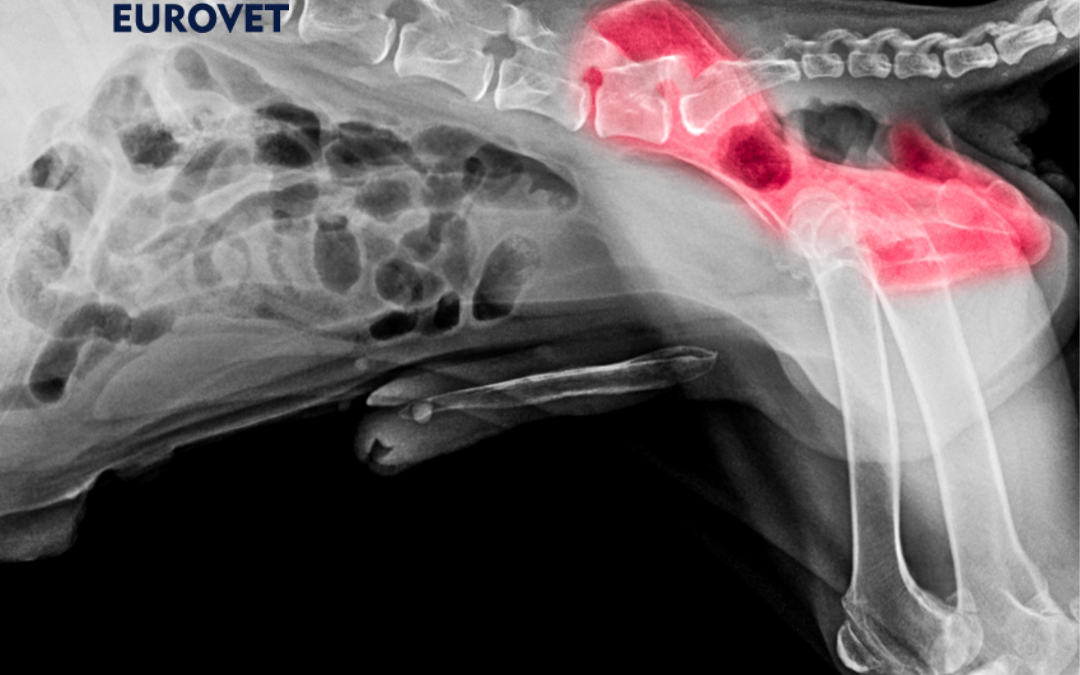
Hip dysplasia is a developmental orthopedic disorder that mainly affects dogs (it can also appear in cats, though more rarely). It is characterized by a mismatch between the femoral head (the “ball” of the thigh bone) and the acetabulum (the “socket” of the pelvis where the ball should fit).
Under normal conditions, this joint functions like a perfectly designed ball-and-socket mechanism: the ball glides smoothly into the socket, thanks to cartilage and synovial fluid. In dysplasia, however, the “ball” does not fit properly into the “socket,” which causes joint instability (also known as joint laxity). Over time, this misfit leads to repeated microtrauma, cartilage wear, and ultimately secondary osteoarthritis.
To put it humorously: hip dysplasia is like buying a shoe in size 42 and forcing a size 38 foot into it. At first it somehow fits, but it slips, causes blisters, and eventually hurts. The difference is that in animals you can’t just change the shoe… that’s where veterinary medicine comes in!
Hip dysplasia is a degenerative disease that doesn’t appear out of nowhere: it has a genetic basis and develops early in life, but often only shows when the dog is older. Then pain, lameness, and mobility problems become part of daily life. Understanding how genetic and environmental factors interact is key to preventing, detecting early, and improving the quality of life of senior dogs.
Breed and size: predisposition is not a sentence
Hereditary predisposition is without a doubt one of the main pillars of hip dysplasia. It has been proven to be a polygenic inheritance, meaning it does not depend on a single gene but on several, which interact with each other and with the environment. This explains why two dogs with perfect hips can produce a dysplastic puppy – and vice versa.
Large and giant breeds are the most affected, especially Labrador Retrievers, German Shepherds, Rottweilers, Saint Bernards, and Spanish Mastiffs. In these breeds, the risk lies not only in genetics, but also in the fact that their fast growth and heavy body mass place stress on the hips very early on. That is why responsible breeding programs include official radiographs to exclude dysplastic dogs from reproduction.
A minute of history
Hip dysplasia was first described in the 1930s in show dogs. It was noted that larger and more robust dogs developed chronic lameness.
Accelerated growth: when the body outpaces the bones
Growth rate in the first 6 to 12 months plays a crucial role. A puppy that goes from “fluffy toy on legs” to “giant teenager” in just weeks subjects its joints to disproportionate stress. The skeleton is not yet fully ossified, muscles are immature, and ligaments don’t yet have the strength to stabilize the hip joint.
This biomechanical imbalance favors joint laxity, or insufficient firmness between femoral head and acetabulum. From that point on, each repeated movement causes microtrauma that, over time, leads to wear and secondary osteoarthritis.
In other words: a puppy that grows too fast is like putting a heavy piece of furniture on foundations made of clay.
Your veterinarian’s advice:
In many young dogs with mild dysplasia, the gluteal and lumbar muscles compensate for the joint laxity… until sarcopenia sets in with age. Then the disease becomes obvious. If you have a puppy from a large or giant breed, talk to your veterinarian about orthopedic evaluation before its first birthday. A preventive X-ray can change the entire joint future of your dog.
Nutrition
Feeding is another key factor. For years, it was thought that “feeding a lot so the puppy grows big and strong” was enough. A monumental mistake. Excess calories accelerate weight gain and multiply the stress on still-immature hips.
Calcium and phosphorus also play a fundamental role. Too much calcium in the diet disrupts normal endochondral ossification, which can result in disproportionate or poorly formed bones. Likewise, imbalanced calcium-phosphorus ratios affect the development of growth plates.
Did you know? The delicate dance of calcium and phosphorus in canine nutrition 🦴
Calcium and phosphorus are the main builders of the skeleton, and their balance is essential for bone health. In adult dogs, the ideal ratio is 1.2 to 1.4 : 1, meaning there should always be slightly more calcium than phosphorus to keep bones strong. In large breed puppies undergoing very rapid growth, the ratio must be higher, between 1.8 and 2.1 : 1, to ensure proper ossification and protect the joints.
When this balance is disturbed, problems arise: too much phosphorus promotes bone demineralization and increases the risk of hip dysplasia, while too much calcium interferes with cartilage mineralization and can cause deformities. That’s why foods formulated specifically for large breed puppies include controlled energy density and precise mineral balance to ensure safe development.
In short: it’s not about feeding more, but about feeding right. Calcium and phosphorus must dance in step – if one steps on the other’s feet, bones lose their rhythm.
That’s why, for predisposed breeds, it is always recommended to use diets specifically designed for large breed puppies, since they limit energy density and adjust mineral intake.
Summing up: overfeeding a predisposed puppy is like inflating a balloon too quickly… sooner or later, it will burst.
Exercise: neither marathon nor sofa
Exercise is healthy, but as always, it’s about balance and context. A genetically predisposed puppy shouldn’t spend its childhood jumping hurdles, running alongside a bike, or living on slippery floors that constantly make its hips “slide.”
Repeated microtrauma at a young age worsens joint laxity and accelerates degeneration. The goal is not to raise a “glass dog” or to avoid activity altogether, but to regulate the type and intensity of exercise. Controlled walks, calm play on firm ground, and gradual muscle strengthening are recommended.
The problem arises when too much is demanded, too soon. It’s like asking a teenager to lift the same weights as a professional bodybuilder: the result is almost always injury.
Early detection: the key is to look before it hurts
You don’t have to wait for the dog to limp before taking action. In predisposed breeds, a preventive X-ray between 4 and 6 months can reveal the first signs of dysplasia. This opens the door to preventive interventions – such as physiotherapy or early surgery – before the damage becomes irreversible. At Eurovet, we apply this as part of our orthopedic protocols for young dogs.