- Clinica Veterinaria Eurovet - Avenida Estación, 38 - 12598 - Peñiscola
- +34 964 784 983
- +34 671 281 025
- clinica.eurovet@gmail.com



Pre-, peri- and post-surgical risks of sterilisation
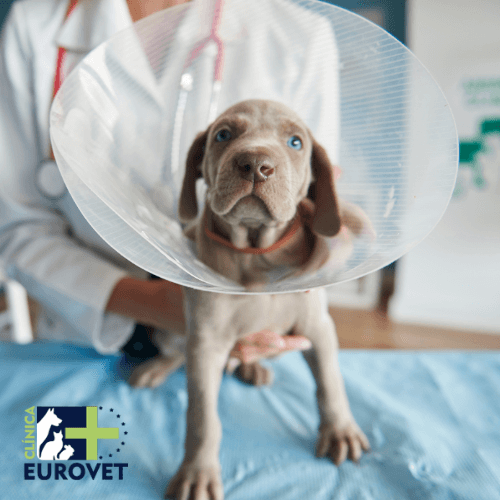
“Surgery, yes, but with caution” 😄
Like any surgery, sterilisation is not risk-free, whether in dogs or cats. It is normal for you, as a guardian, to worry that “something will go wrong” when your animal goes into the operating theatre. The good news is that the current clinical reality is far less dramatic than the stories that circulate: sterilisation is a routine, highly protocolised procedure with a low and well-known complication rate in both canine and feline medicine.
In large clinical studies on elective sterilisation in healthy animals, the overall incidence of complications is approximately 5-12%, with the vast majority being mild and transient (local inflammation, small seromas, post-operative discomfort). Complications considered serious rarely exceed 1-2%. In female cats, these figures are usually even lower, due to shorter surgical times and less abdominal manipulation.
Anaesthetic mortality associated with elective surgery in healthy patients has been estimated at around 0.05–0.1% in both dogs and cats, figures comparable to routine procedures in human medicine. That is why we insist so much on seemingly simple aspects, such as respecting fasting, avoiding unnecessary stress before surgery, or reporting any recent symptoms: these are not formalities, they are factors that directly influence measurable results.
In veterinary medicine, there is no such thing as zero risk. But there is a clearly favourable risk-benefit ratio. On the other side of the scale are pathologies whose frequency is well documented. In female dogs, it is estimated that between 19 and 25% will develop pyometra during their lifetime if they are not spayed. In cats, although pyometra is less common, it does exist and can go unnoticed until advanced stages. In both species, sterilisation virtually eliminates the risk of this potentially fatal condition.
As for mammary tumours, the data is even more compelling in felines: while approximately 50% of mammary tumours in female dogs are malignant, in female cats more than 85–90% are malignant, with a much more aggressive behaviour. In addition, early sterilisation reduces the risk of mammary tumours in female cats by up to 86–91%, and in female dogs by up to 99.5% if performed before the first heat.
The intention of this article is not to alarm, but to clearly explain what can happen, why it happens, and how it is prevented in modern clinical practice.
What exactly is the surgery? (and why does it sound more dramatic than it is?)
In dogs and cats, sterilisation is performed under general anaesthesia and can be carried out using two main techniques. The best known is ovariohysterectomy (OVH), which involves the removal of the ovaries and uterus. Another widely used option is oophorectomy (OVE), in which only the ovaries are removed.
From an endocrine point of view, both techniques are equivalent in healthy animals: removing the ovaries suppresses the production of oestrogen and progesterone, the hormones responsible for the reproductive cycle and most associated pathologies. In cats, ovariectomy is particularly common due to the low incidence of primary uterine pathology and the technical simplicity of the procedure.
Comparative studies show that, in animals without uterine abnormalities, OVE offers the same protection against pyometra and mammary tumours as OVH. However, when there are uterine changes, a history of infection, repeated pseudopregnancies or intraoperative findings, OVH remains the technique of choice in both species.
For the guardian, active participation does not mean mastering surgery, but understanding the medical logic: asking what technique is proposed and why, reporting previous cycles, behavioural changes, hormonal treatments or abnormal episodes provides key information. Practical details such as a prior walk (for bitches), a calm environment, or bringing a blanket with the smell of home help to reduce stress and facilitate a smoother recovery.
Possible risks (rare, but real): what can happen and how to understand it
Most complications associated with sterilisation are minor, predictable and treatable, both in female dogs and cats. Knowing about them does not increase the risk, but it does improve your ability to react in time.
Anaesthetic risk: the ‘heart’ of safety
General anaesthesia affects key systems such as the cardiovascular and respiratory systems. In healthy bitches, serious anaesthetic events are rare, especially when balanced protocols and continuous monitoring are used. In multicentre studies, the incidence of significant anaesthetic complications in elective surgery remains below 1%, and most are resolved by intraoperative adjustments with no subsequent consequences.
Did you know: modern anaesthesia is safer than it was 20 years ago
Anaesthetic mortality rates in small animals have fallen by more than 50% in the last two decades, mainly due to monitoring, not surgical technique.
Factors such as transient hypotension, hypothermia, or mild hypoventilation are relatively common, but that is precisely why they are part of standard monitoring. On a practical level, avoiding self-medication at home and following the guidelines has a direct impact on safety, as some human drugs interfere with anaesthesia or coagulation.
Intraoperative bleeding: rare, but more likely in adults
Significant bleeding during sterilisation is rare (generally <1%). In adult or oestrus bitches, the risk may be slightly higher due to increased vascularisation. In queens, bleeding is usually minimal, although it is still controlled with ligation and haemostasis techniques. Marked weakness, pale gums or abdominal distension should not be considered normal after surgery and warrant immediate review.
Wound infection and seromas: the most common, but rarely serious
Surgical incision infections have a low incidence, usually less than 5%, and in most cases are limited to superficial processes. Seromas, accumulations of fluid under the skin, are one of the most common minor complications and do not involve infection or surgical failure; they usually resolve with rest and monitoring. Practical prevention is clear: avoiding licking and sudden movements significantly reduces these incidents.
Suture dehiscence and mechanical complications
Wound opening is usually related to excessive early activity. This is especially relevant in young animals that recover quickly and “feel well” before the tissues have healed internally. Initial rest is key in dogs and cats, although control is usually easier in indoor cats. Internally, healing of abdominal tissues after sterilisation usually requires a minimum of 10 to 14 days, even though the animal may appear to be back to normal activity within the first 48–72 hours. This difference between external well-being and deep tissue repair explains many avoidable complications, such as dehiscence or post-operative inflammation.
Our intradermal suture🧵✨: when the details make the difference 💪🏻!
At Eurovet Veterinary Clinic, sterilisation procedures are systematically closed with intradermal sutures, an advanced technique in which the thread remains completely under the skin, with no visible stitches on the outside. This has very specific advantages:
1 – as there are no external stitches, there is no need for bandages or Elizabethan collars, as licking does not compromise the suture
2 – The wound leaves a very discreet scar, sometimes even imperceptible
3 – Skin healing is faster and more aesthetic, usually taking 5 to 7 days.
4 – As the material is absorbable, there is no need to remove stitches, avoiding an additional visit, reducing stress for the animal and making it easier for owners to organise.
A technique copied from discreet but key human cosmetic surgery, reflecting a surgical approach focused on patient comfort, post-operative safety and the quality of our service!
How we minimise risks: the “triple lock” of safe sterilisation 🔒🔒🔒
Surgical safety is based on three pillars that work together.
Pre-surgical assessment allows hidden abnormalities to be detected. Blood tests identify liver, kidney or haematological problems which, even if they do not cause symptoms, can increase the anaesthetic risk. This assessment is particularly relevant in adult, geriatric or medically compromised animals.
Continuous anaesthetic monitoring is one of the greatest advances in modern veterinary surgery. Monitoring oxygenation, heart rate, ventilation and temperature reduces both the incidence and severity of complications. This monitoring continues after surgery: the first few hours are key to detecting pain, vomiting or hypothermia, especially in female cats.
The surgical technique and pain management directly influence recovery. Untreated pain increases stress, delays healing and encourages risky behaviour. Multimodal analgesia has been shown to improve well-being in both dogs and cats, something that the owner can identify by observing posture, breathing, appetite and quality of rest.
Post-operative care at home: where many points are won (or lost)
Most preventable complications occur in the home environment. External recovery is usually rapid, but internal healing takes time. Rest, licking control, and strict adherence to medication have a direct impact on reducing complications.
Key clinical fact📌: most “emergencies” are not emergencies
More than 80% of post-sterilisation emergency consultations are due to normal post-operative signs (mild inflammation, temporary apathy), but providing the right information beforehand drastically reduces these visits… and the guardian’s anxiety.
Furthermore, a study on post-sterilisation follow-up revealed that more than 75% of complications (licking, dehiscence, excessive inflammation) occur outside the clinic, in the first 5 days after surgery.
Female cats often hide pain or discomfort, so subtle changes in behaviour, reduced interaction or lack of appetite should be monitored closely. In female dogs, excessive activity is the main risk. Photographing the wound daily helps to objectively assess changes and avoids misinterpretation.
Fever, purulent discharge, increasing pain, marked apathy or persistent vomiting are not normal effects and warrant veterinary review.
Key ideas ✅
Overall, elective sterilisation in healthy female dogs and cats has one of the best risk-benefit ratios in all of preventive veterinary medicine. With serious complication rates generally below 1–2%, compared to much higher cumulative risks of reproductive and neoplastic diseases in intact animals, scientific evidence strongly supports this procedure when performed in a planned and responsible manner. In conclusion, the risks exist, but they are well studied, quantified, and controlled. Sterilisation is not only a reproductive decision, but also an evidence-based preventive health tool.
Sources and recommended reading
Schneider, R., Dorn, C. R., Taylor, D. O. N. (1969) – Factors influencing the occurrence of mammary tumours in bitches – Journal of the National Cancer Institute – Classic epidemiological study demonstrating the direct relationship between the timing of spaying and the dramatic reduction in the risk of mammary tumours in female dogs – https://academic.oup.com/jnci/article-abstract/43/6/1249/910225
Egenvall, A., Hagman, R., Bonnett, B. N., Hedhammar, A., Olson, P., Lagerstedt, A. S. (2001) – Risk of pyometra according to breed in insured female dogs in Sweden – Journal of Veterinary Internal Medicine – Large-scale population analysis quantifying the lifetime incidence of pyometra in intact bitches and demonstrating its high frequency in unspayed animals – https://onlinelibrary.wiley.com/doi/10.1111/j.1939-1676.2001.tb02354.x
Brodbelt, D. C., Blissitt, K. J., Hammond, R. A., et al. (2008) – Risk of perioperative mortality in small animals – Veterinary Anaesthesia and Analgesia – Multicentre benchmark study evaluating anaesthetic mortality in veterinary surgery and confirming the low risk in elective procedures such as sterilisation – https://doi.org/10.1111/j.1467-2995.2007.00317.x
Okkens, A. C., Kooistra, H. S., Nickel, R. F. (1997) – Comparison of the long-term effects of ovariectomy and ovariohysterectomy in female dogs – Journal of Reproduction and Fertility Supplement – Comparative study demonstrating the endocrine and preventive equivalence of both techniques in healthy female dogs – https://pubmed.ncbi.nlm.nih.gov/9404290/
Salmeri, K. R., Bloomberg, M. S., Scruggs, S. L., Shille, V. (1991) – Long-term effects of gonadectomy in dogs – Journal of the American Veterinary Medical Association – Review analysing the medical benefits and possible side effects of sterilisation in dogs – https://avmajournals.avma.org/view/journals/javma/198/7/javma.1991.198.7.1193.xml
Overley, B., Shofer, F. S., Goldschmidt, M. H., Sherer, D., Sorenmo, K. U. (2005) – Association between early spaying and risk of mammary tumour in cats – Journal of Veterinary Internal Medicine – Study demonstrating an up to 86% reduction in the risk of mammary tumours in cats spayed at an early age – https://pmc.ncbi.nlm.nih.gov/articles/PMC6070019/
Hart, B. L., Hart, L. A., Thigpen, A. P., Willits, N. H. (2014) – Long-term effects of neutering on the health and longevity of dogs – PLoS ONE – Retrospective analysis of tens of thousands of records showing a significant increase in life expectancy in neutered dogs – https://journals.plos.org/plosone/article?id=10.1371/journal.pone.0102241
Root Kustritz, M. V. (2012) – Determining the optimal age for sterilisation of dogs and cats – Journal of the American Veterinary Medical Association – Scientific review concluding that there is no universal ideal age and that the decision must be individualised according to the patient – https://avmajournals.avma.org/view/journals/javma/241/1/javma.241.1.66.xml
Hagman, R. (2018) – Pyometra in dogs: pathogenesis, diagnosis and treatment – Reproduction in Domestic Animals – Modern review explaining the hormonal and bacterial mechanisms involved in pyometra and reinforcing sterilisation as the only definitive prevention – https://onlinelibrary.wiley.com/doi/10.1111/rda.13150
Sorenmo, K. U., Kristiansen, V. M., Cofone, M. A., et al. (2009) – Canine mammary tumours: epidemiology, diagnosis and treatment – Veterinary Pathology – Comprehensive review contextualising the high prevalence of mammary tumours in intact bitches and their relationship to hormonal exposure – https://journals.sagepub.com/doi/10.1354/vp.08-VP-0228-S-REV