- Clinica Veterinaria Eurovet - Avenida Estación, 38 - 12598 - Peñiscola
- +34 964 784 983
- +34 671 281 025
- clinica.eurovet@gmail.com



From ‘heat’ to the oestrous cycle
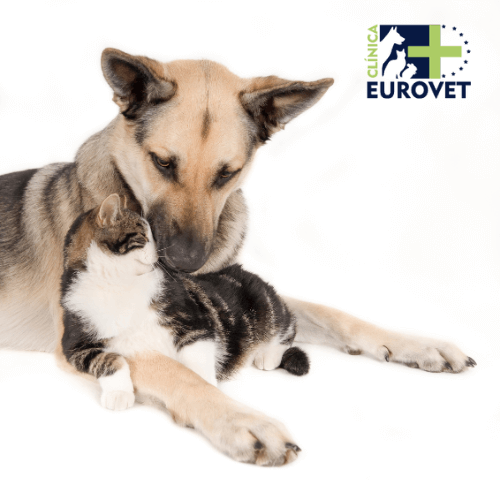
The practical (and drama-free) guide to understanding your dog or cat
Did you know that your dog or cat’s behaviour can change radically during heat? It is normal to notice changes in their mood, hygiene habits, appetite or even in the way they interact with you and other animals. This is no coincidence: it is the result of a complex biological process called the oestrous cycle, which regulates their fertility and readiness for reproduction.
But the oestrous cycle is not just a physiological phase: it is a stage that can profoundly influence their well-being and coexistence in the home. Some pets become more affectionate, others more restless or even aggressive, and in the case of female cats, they may vocalise intensely during the night. All of this can lead to anxiety, frustration or risky behaviours such as escapism or unwanted mounting.
That is why understanding how this cycle works is essential. Knowing how long it lasts, when ovulation occurs and what symptoms alert us to its onset allows us to take preventive action and make responsible decisions. Among these, the most important is sterilisation, a measure that not only prevents unwanted pregnancies but also improves the quality of life of our pets.
In this article, I explain in a clear and practical way what the oestrous cycle is like in dogs and cats, what its phases are and what differences exist between the two species. This will allow you to easily recognise when your furry companion is in heat and consult your vet in time about the best time to act.
Phase by phase: what happens in the body… and what complicates (or facilitates) your life at home
Identifying the start of the cycle (and not just “seeing blood”) allows you to prevent escapes, unwanted mating and reduce stress at home.
The bitch: four distinct (and fairly predictable) phases
In female dogs, the oestrous cycle is classically described as proestrus, oestrus, diestrus and anaestrus. The useful thing is that it is usually relatively orderly, which allows you to anticipate it.
Proestrus (start of heat)
This lasts about 9 days on average, although it can vary greatly (from 2 days to 3 weeks). What happens inside: oestrogen levels rise, which ‘prepares’ the reproductive tissues.
What you see: swollen vulva and bleeding (sometimes very slight). The bitch attracts males… but does not normally accept mounting.
Your vet advises:
This is when the ‘movie situations’ begin: males appearing ‘out of nowhere’, more tense walks, and a real risk of escape (the bitch may try to go out in search of interaction). My practical advice: during this phase, keep a closer eye on her during walks, avoid dog parks if there are males running loose, and if she lives in a garden, check the locks as if you were a hacker with time on your hands.
Oestrus (fertile phase: here there is a real risk of pregnancy)
This also lasts an average of ~9 days, but can be as short as 3 days or as long as 3 weeks.
What happens inside: oestrogen levels drop and progesterone levels rise.
Interesting technical fact: ovulation occurs during oestrus, approximately 2–3 days after the LH surge.
What you see: the discharge may become lighter (“straw-coloured”) and the vulva softens; the bitch may accept mounting.
This is the phase when “just one minute” can lead to an unwanted pregnancy. If you don’t want litters: extreme control. And beware of the counterintuitive: some bitches bleed less just when they are most fertile, so don’t use bleeding as a “traffic light”.
Linguistic curiosity: ‘oestrus’ comes from a fly that drives you crazy
The term oestrus/oestrus comes from the Greek oistros (“horsefly”), associated with “frenzy/impulse”. Quite appropriate for some nights in heat 😅
Source: https://www.etymonline.com/word/estrus
Diestro (after oestrus: the great hormonal theatre)
Something very counterintuitive happens here: whether or not there is pregnancy, the bitch’s body enters a stage dominated by progesterone. This is why some develop pseudopregnancy: behaviours and physical signs similar to actual pregnancy (nesting, “adoption” of toys, changes in appetite, even milk). In plain language: the organism “believes it”.
In pseudopregnancy, avoid reinforcing nesting behaviours, control mammary licking (lactation may continue) and consult your vet if there is pain, fever, marked apathy or abnormal secretions.
Anestrus (sexual rest)
This is a long phase of ‘reproductive silence’ before the next cycle. The practical advantage: it usually gives you months of normality.
The cat: the queen of “repeat mode” (and it depends on light)
In female cats (queens), the cycle is greatly influenced by the photoperiod (hours of light). In other words: more light = more sexual activity. In scientific terms, female cats are seasonally polyestrous (they have multiple heat cycles within a season).
Key practical fact (which explains a lot):
An indoor cat with artificial light can “trick” its biological system. In fact, it has been reported that with around 14 hours of artificial light per day, they can cycle practically all year round.
Translation: at home, heat can become a Netflix series… without a “skip intro” button.
In addition, she is induced to ovulate: ovulation is usually triggered by the stimulus of copulation (she does not “ovulate just because”, like a bitch).
Proestrus (sometimes not even noticeable)
It can last 0–2 days and in many cats goes unnoticed.
Oestrus (heat: the famous ‘night-time concert’)
This is when the typical signs appear: intense vocalisation, rolling on the ground, rubbing, lordosis (posture), actively seeking contact, restlessness. They do not usually bleed like dogs (if there is bleeding, other causes must be considered).
On average, each heat can last ~7 days, but with very wide ranges.
Interestro / Postestro
If there is no mating/ovulation, many cats come out of heat for a few days and then go back into heat relatively soon, maintaining the repetitive pattern typical of the species. The complete cycle can last from 1 to 6 weeks, with an approximate average of ~3 weeks.
How often do they go into heat?
The bitch: the typical… and what is normal without being “typical”
In general, female dogs go into heat approximately every 6–8 months (many have “two heats per year”, although there is individual variability and variability based on size/breed). This pattern is usually summarised as a “every ~6 months” cycle in most domestic dogs.
What factors really influence this:
- Size/breed: small breeds tend to mature earlier; large breeds may have their first heat later.
- Age: after the first heat, the pattern may stabilise or remain irregular for a while.
- Overall health and body condition: reproductive biology is not unrelated to metabolic status.
Your vet advises:
Make a note of three things on your mobile phone: the start date of bleeding, changes in behaviour and when she stopped attracting/accepting males. This record is very helpful in the consultation if there are irregularities, and also for planning trips, stays or cohabitation with males.
The cat: “How often?” = It depends on the light (and whether she is ovulating)
During the breeding season (long days), a cat may go into heat repeatedly at a frequency that, in practice, many owners experience as “every so often”. In layman’s terms: if she does not mate, she may have short periods of heat and rest, and the entire cycle may average ~3 weeks, although the total range is from 1 to 6 weeks. And a crucial reminder: female cats are induced ovulators.
Brutal practical impact (on human cohabitation and rest):
- If she lives indoors with abundant light, she may come into heat very frequently and for months at a time.
- Vocalisations and restlessness are not “whims”: they are reproductive behaviour.
Dog VS Cat: key differences
Why are they so different? It is not that one species is ‘more intense’ than the other: it is that each is executing a different biological algorithm. This is where comparative biology comes in: dogs and cats come from different reproductive strategies.
- Canines (including dogs) descend from species with a social structure and reproduction that is relatively “synchronised” in certain contexts. A more spaced-out cycle with a long anoestrus may make sense in terms of energy and offspring care: fewer opportunities per year, but more investment per litter.
- Domestic felines descend from a lineage where reproduction can take advantage of favourable windows (season with more resources) and where induced ovulation is an efficient strategy: ovulating when mating increases the probability that ovulation will be “worth it” (i.e., that sperm will be available). The photoperiod in female cats is a classic example of how the environment modulates reproduction: more hours of light are associated with historically more favourable conditions for breeding.
| Characteristic | Female dog | Cat |
|---|---|---|
| First heat (approx.) | Usually from 6–12 months (variable depending on size/breed) | Usually from 5–10 months (variable) |
| Pattern | More “spaced out” (often ~2/year) | Seasonally polyestrous (several heats per season) |
| Ovulation | Spontaneous (does not require copulation) | Induced (copulation usually triggers ovulation) |
| Typical signs | Bleeding, swollen vulva, behavioural changes | Vocalisation, rubbing, posture, restlessness; atypical bleeding |
| Key “hidden” factor | Hormones from the male → pseudopregnancy may occur | Photoperiod: more light = more oestrus |
👩⚕️ Your vet advises you
If unusual signs appear (excessive bleeding, foul odour, fever, apathy, vomiting, distended abdomen, purulent vulvar discharge), do not dismiss it as “heat-related”: some reproductive emergencies masquerade as normal behaviour at first.
Informative capsules
Key idea
Correctly identifying the phases of the oestrus cycle allows you to plan sterilisation at the safest time for your pet’s health.
Did you know?
In some breeds, such as German Shepherds and Labradors, heat can be more intense and prolonged, causing greater stress for both the pet and its owners.
Practical application
Consult your trusted vet about the best time to spay or neuter your pet, especially if it has already been in heat for the first time.